Open Knowledge Maps
Creates visual knowledge maps to explore and discover scientific literature on any research topic.
Are you the owner?
Claim this tool to publish updates, news and respond to users.
Sign in to claim ownership
Sign InDescription
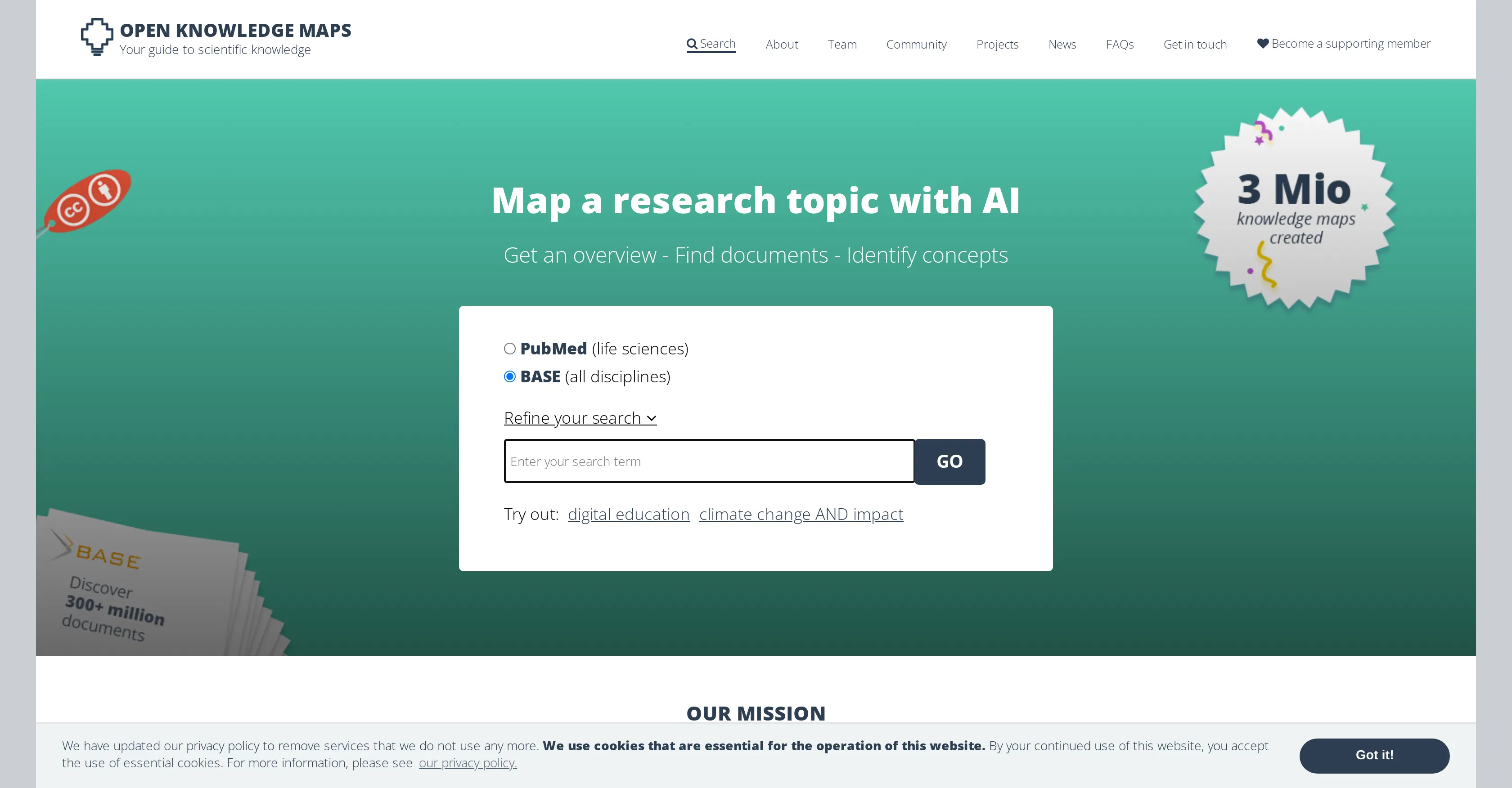
Open Knowledge Maps is an AI-powered discovery tool that creates interactive visual overviews of scientific topics to dramatically improve the visibility of research. Developed as a non-profit open-source project, its core mission is to make scientific knowledge more accessible and comprehensible for researchers, students, and the general public alike. The primary value lies in transforming the traditional, linear list of search results into a two-dimensional map, where related papers are grouped into topical clusters, allowing users to grasp the structure of a field and identify key papers and sub-topics at a glance.
Key features: The tool generates visual knowledge maps based on a user's search query, clustering the most relevant papers from open-access repositories like PubMed and BASE. Users can explore these maps interactively, zooming into clusters to see paper details, abstracts, and direct links to full texts. It supports searching by keyword or DOI and allows for the creation of public or private maps that can be shared and embedded. The interface is designed for intuitive exploration, enabling rapid identification of literature gaps, seminal works, and emerging trends without manually sifting through hundreds of search results.
What makes it unique is its focus on open science and its specific visual metaphor for knowledge discovery, which is powered by a dedicated search index and clustering algorithms. Unlike standard academic search engines, it prioritizes visual synthesis and overview before deep diving into texts. The platform is web-based, requiring no installation, and is built on open infrastructure to ensure transparency and community-driven development. While it integrates with major open-access databases, its technical architecture is designed to be extensible, supporting the inclusion of new data sources in the future.
Ideal for academic researchers conducting literature reviews, students beginning work on a thesis or project, librarians supporting research activities, and science communicators seeking to understand and explain complex fields. Specific use cases include quickly surveying a new research area before a deep dive, identifying foundational papers for a systematic review, teaching information literacy and research skills in educational settings, and fostering interdisciplinary discovery by visually revealing connections between disparate sub-fields.